Clash of Kings:The West
- 3.9
- Rating
- 1.00M
- Installs
- Free
- Price

 Analysis by App-foxy
I went into Clash of Kings: The West expecting a familiar mobile strategy game, but its appeal became clearer after spending time with its longer-term rhythm. This is not the kind of game I would recommend only for quick, isolated matches. It is built around planning, patience, and the satisfaction of watching a developing kingdom become more capable over time. That makes it rewarding when I have a few minutes to check decisions throughout the day, but less suitable when I want immediate action with no waiting or preparation.
Developed by Elex Wireless, this free strategy game places its focus on competition with players from around the world. It is rated Teen, and the current version is 2.150.0, with support for devices running Android 6.0 or later. The broad idea is easy to understand: establish yourself, improve your position, and make choices that help you compete more effectively. The interesting part is not the basic premise; it is deciding which improvements deserve attention first and how much commitment I want to give the game on a regular basis.
How the first goals shape the experience
I found that the opening goals do more than introduce the basic loop: they teach me to connect each choice with what I want my kingdom to handle next. That early habit matters most when I’m sharing a device, because a clear goal makes it easier to pause without leaving a confusing trail of half-decisions. The next section looks at how progress cues help make those choices easier to follow.
You May Also Like

 Blood Strike: 2.5 Anniversary
Blood Strike’s Loadouts Turn Every Drop Into a Tactical Gamble
A close look at Blood Strike’s custom loadouts: how fast access to signature weapons reshapes its battle royale rhythm, rewards preparation, and narrows the gap between fights.

 Pandora - Music & Podcasts
Pandora’s Music Is Easy to Start, but Harder to Recover
Pandora’s strength is its low-effort path from a seed to a station. Its weak spot is how much confidence it asks you to place in connection, setup, and quiet recovery.

 8 Ball Pool
 Is Built on Rivalries, Rematches, and Routine
A close look at the rivalries, rematches, shared routines, and unanswered safety questions that turn a quick pool match into a persistent mobile community.

 Samsung Music
’s Quiet Strength Is Playing What You Already Own
Its reach comes less from spectacle than from dependable access to a personal library. That simplicity is both the app’s strongest retention engine and its ceiling.

 AccuWeather: Weather Radar
AccuWeather Review: A Quick, Clear Forecast for Everyday Decisions
For everyday plans, the best forecast is the one you can understand quickly. AccuWeather makes rain timing, radar, and local conditions easy to act on, with a few trade-offs.

 Hill Climb Racing
Why Hill Climb Racing Still Turns Crashes Into One More Run
A tiny car, a bumpy hill and one more upgrade: Hill Climb Racing keeps resurfacing because its simple chaos makes every near-miss feel personal.
More From Our News Desk



A clear beginning, but not a completely casual one
The opening hours work best when I treat them as a learning period rather than a race to become powerful immediately. Early objectives give me a reason to keep moving, and the game gradually encourages me to think about the relationship between development and competition. I found that the most useful early habit was reading each task as a lesson about priorities instead of tapping through it simply to collect the next reward.
That distinction matters because a strategy game can easily become a checklist. Here, the checklist is more useful when it helps me understand what my settlement needs next. An early upgrade may improve my position in a visible way, while another choice may prepare me for later demands. I preferred making a short plan before spending resources, especially when several improvements appeared attractive at the same time.
New players should not expect every decision to have an immediate dramatic result. The early stage is about creating a base for later progress. I enjoyed that measured start because it gave me room to learn the game’s priorities without throwing me into a complicated contest immediately. Players who want a fast tutorial followed by constant battles may find the opening slower than expected.
Why the first choices matter
My practical advice is to avoid treating every available upgrade as equally urgent. I had a better experience when I chose improvements according to a simple question: will this help me complete current goals, prepare for the next stage, or protect my ability to keep progressing? That approach is more reliable than spending resources whenever a button lights up.
This is also where the game begins to separate itself from very lightweight strategy titles. It asks me to think beyond the next tap. Even when the early goals are approachable, they teach a habit of planning around timing. If I started an improvement and then left the game, I wanted that decision to remain useful when I returned rather than feeling like a random action.
A realistic everyday use case is a short morning check before work or school. I can review what is developing, decide which objective deserves attention, and leave the game with a clear next step. Later, I can return to collect progress and adjust the plan. That routine suits the game much better than trying to force a long uninterrupted session out of it.
Progress signals that make development understandable
As development advances, visible progress gives me a practical way to explain what has changed since my last visit, rather than relying on memory or a long session. I’d use that as a simple handoff aid on a shared device: agree on the next objective, then check whether the game’s progress supports it before making another change. From there, the experience becomes more demanding as choices carry greater weight.
Visible growth is the main reward
The strongest part of the progression is the sense that my decisions gradually change what I can do. Improvement is not only about receiving a new label or moving to another stage. It is about having a more capable position from which to pursue the next objective. I could feel the difference between simply maintaining a settlement and actively preparing it for greater demands.
That feeling is important in a game with a long-term structure. If progress were hidden behind vague menus, I would lose interest quickly. Instead, the game gives me enough direction to understand why the next step matters. I still had to decide how aggressively to pursue it, but I was rarely left wondering what kind of action the game expected from me.
I also liked that progress creates new questions rather than ending the decision-making. Improving one area can make another weakness more noticeable. That kept the experience from becoming a straight line where every upgrade automatically solves the next problem. The result is a gradual shift from learning the rules to managing trade-offs.
Unlocks feel better when I plan around them
Unlocks are most satisfying when I work toward them with a purpose. If I played only to claim the next available item, the experience felt routine. When I connected an unlock to a larger plan, such as improving my ability to handle future challenges, the same reward felt more meaningful.
One non-obvious lesson I took from the game is that progress should be judged by readiness, not just by quantity. A larger collection of improvements does not automatically mean I am prepared for competition. I got better results by asking whether my current development supported the way I actually wanted to play. Someone who enjoys cautious growth may make different choices from someone who wants to compete more directly, and the game leaves room for that distinction.
This is also why I would not recommend rushing through every goal. Moving quickly can feel exciting, but it may leave the rest of the settlement out of balance. A slower player who understands the reason behind each improvement can sometimes enjoy a smoother experience than someone who advances quickly without a plan.
How I would organize a normal play session
My preferred routine is simple. I begin by checking the active goal, then review which development choice supports it most directly. After that, I look at the next likely obstacle before committing resources. This takes only a short time, but it prevents the common mistake of finishing one task and immediately creating a new problem.
When I have more time, I use the session to compare several possible paths rather than making every decision as soon as it becomes available. That is where the strategy layer becomes more enjoyable. The game rewards attention to sequence: what I do now affects how comfortable the next stage feels.
Players who dislike planning may still enjoy the early objectives, but they may become frustrated once the game expects more deliberate choices. In my experience, the best way to keep it relaxing is to accept that not every goal needs to be completed immediately.
Where the difficulty curve becomes more demanding
The later challenge is less about learning a completely different game and more about making careful decisions under growing pressure. On a shared device, that makes boundaries especially useful: deciding who is responsible for the next move can prevent two players from pursuing conflicting priorities. The following section considers how the game’s ongoing goals can encourage frequent returns—and when that rhythm stops feeling enjoyable.
The challenge grows through pressure, not just complexity
The difficulty does not need to become confusing to become demanding. The pressure comes from having more reasons to think before acting. Early goals can be approached with a broad understanding of the game, while later progress benefits from knowing what I am preparing for and how much flexibility I want to keep.
I noticed that mistakes became more expensive once I stopped treating resources and time as interchangeable. An attractive short-term decision could slow a more important objective. This made the game more interesting, but it also meant that casual experimentation was less comfortable than it was at the beginning.
The curve works for players who enjoy gradual responsibility. I liked feeling that the game trusted me with more meaningful choices instead of simply increasing numbers. However, the same design can feel like friction to anyone who wants a constant stream of obvious rewards.
Competition changes the meaning of preparation
The global competitive setting gives preparation more weight. I am not only improving for my own satisfaction; I am also thinking about how my position compares with other players. That creates a stronger reason to maintain a sensible development order, particularly when I know that careless decisions can leave me less prepared than someone who has planned further ahead.
I would not approach this as a purely solitary city-building experience. Even if I spend much of my time developing at my own pace, the competitive context affects how I evaluate progress. A peaceful upgrade is not automatically the best upgrade if it leaves me poorly prepared for the next stage of competition.
At the same time, players should keep their expectations realistic. This is not the right choice if the idea of other players influencing the atmosphere sounds stressful. A single-player puzzle or turn-based strategy game may be better for someone who wants every challenge to remain completely controlled and predictable.
What to do when progress feels slow
When the pace slowed for me, the answer was not always to play more aggressively. Sometimes the better move was to narrow my focus to one meaningful objective and stop scattering attention across several unfinished plans. That reduced the feeling of being stuck and made each return to the game more purposeful.
Another useful adjustment was to stop measuring a session by how many rewards I collected. A productive session could simply mean choosing the right next action, setting up a future improvement, and leaving the game in a better state. That mindset is especially helpful for people playing in short intervals.
The game can still test patience. Free-to-play strategy games often create tension between waiting, planning, and spending, and this one is no exception. In-app purchases range from $0.99 to $299.99 per item, so I recommend deciding in advance how much, if anything, I am comfortable spending. The game is free to start, but players who dislike purchase prompts or feel pressured by optional spending should approach carefully.
Retention pressure and the cost of staying engaged
A persistent strategy game can make a household routine feel coordinated, but its unfinished objectives can also turn casual play into a sense of obligation. I’d keep engagement healthy by agreeing on a modest personal goal and treating missed sessions as a reason to reassess, not to rush or spend. That trade-off leads naturally to the question of who will enjoy the game’s long-term rhythm and who may prefer a less demanding alternative.
Why I kept returning
The main reason I returned was that unfinished goals gave each visit a clear purpose. I rarely opened the game without knowing that there was another decision waiting. That works well for people who enjoy checking progress several times a day, especially when they like seeing a plan develop gradually rather than completing everything in one sitting.
The game also benefits from the natural curiosity of long-term strategy. Once I improved one part of my position, I wanted to see what the next stage would demand. That forward-looking structure can be compelling, but it depends on enjoying the process as much as the outcome.
Its audience is reflected in its scale: it has passed one million installs and holds a 3.9 average from about ninety-one thousand ratings. I read that as evidence of a substantial player base, but not as a guarantee that every player will enjoy the pacing. The experience is quite specific, and its slower strategic rhythm will divide people more than a simple arcade game would.
Where retention can become pressure
The same unfinished objectives that brought me back could also make the game feel demanding. If I missed several days, returning meant reviewing what I had planned and deciding whether my old priorities still made sense. That is manageable, but it is not as effortless as opening a game built around short, self-contained rounds.
I also think the competitive framing can encourage players to compare themselves too often. Comparison can motivate better planning, yet it can also make ordinary progress feel inadequate. My advice is to set personal goals, such as improving one area or completing a particular development step, instead of treating every session as a race against the entire player base.
Spending is another retention concern. The wide range of individual purchase prices means the game is not equally comfortable for every budget. I would skip purchases until I understood the normal progression rhythm. That gives me a clearer sense of whether an item solves a genuine problem or merely shortens a wait that I could accept.
Who should play and who should skip it
I think this game is a good match for someone who enjoys long-term strategy, gradual unlocks, and planning around future goals. It suits a player who can check in regularly, make a decision, and return later without needing constant action. It is also a reasonable choice for someone curious about competing in a broad online strategy setting while still wanting a guided path through development.
I would skip it if I wanted a complete experience in a single sitting, disliked waiting for progress, or preferred strategy games where every match resets the situation. I would also be cautious if spending pressure tends to reduce my enjoyment. A traditional premium strategy game, a turn-based title, or a puzzle game may offer better value for those preferences.
Compared with fast multiplayer strategy games, this feels more deliberate and less immediately explosive. Compared with purely casual builders, it asks more of me because the competitive context makes planning matter. It sits between those two styles: accessible enough to begin without deep expertise, but persistent enough that careless choices can affect later enjoyment.
My progression verdict after living with the pace
After playing through its development loop, I think the progression is strongest when I approach it as a daily strategy routine rather than a constant action game. The early goals provide direction, the visible improvements make the middle stages satisfying, and the increasing pressure gives experienced players reasons to refine their decisions. The pacing is not universally comfortable, but it is coherent.
The biggest strength is the way ordinary improvements become part of a larger plan. I enjoyed deciding whether to pursue immediate progress or prepare for a more demanding stage. That kind of choice is more valuable to me than a game that simply unlocks something new every few minutes without asking why it matters.
The largest weakness is the potential gap between the game’s free entry and the patience its long-term structure may require. The in-app purchase range can make the experience feel less relaxed for players who want to avoid spending, particularly if they compare their progress with more committed competitors. I found it more enjoyable when I accepted that steady development was the intended rhythm.
Version 2.150.0 keeps the game relevant for current players, while the Android requirement of 6.0 or later makes it accessible on a broad range of devices that still support that operating system. I would still judge the experience by personal tolerance for ongoing progression rather than by technical access alone.
My final recommendation is straightforward: try it if you want a free, persistent strategy game that rewards regular planning and gradual improvement. Give it a fair chance by setting modest early goals, keeping spending boundaries clear, and resisting the urge to rush every unlock. Clash of Kings: The West is at its best when progress feels like a plan you are building, not a timer you are trying to escape.
FAQs for Clash of Kings:The West
01What is Clash of Kings: The West, and how does the gameplay work?
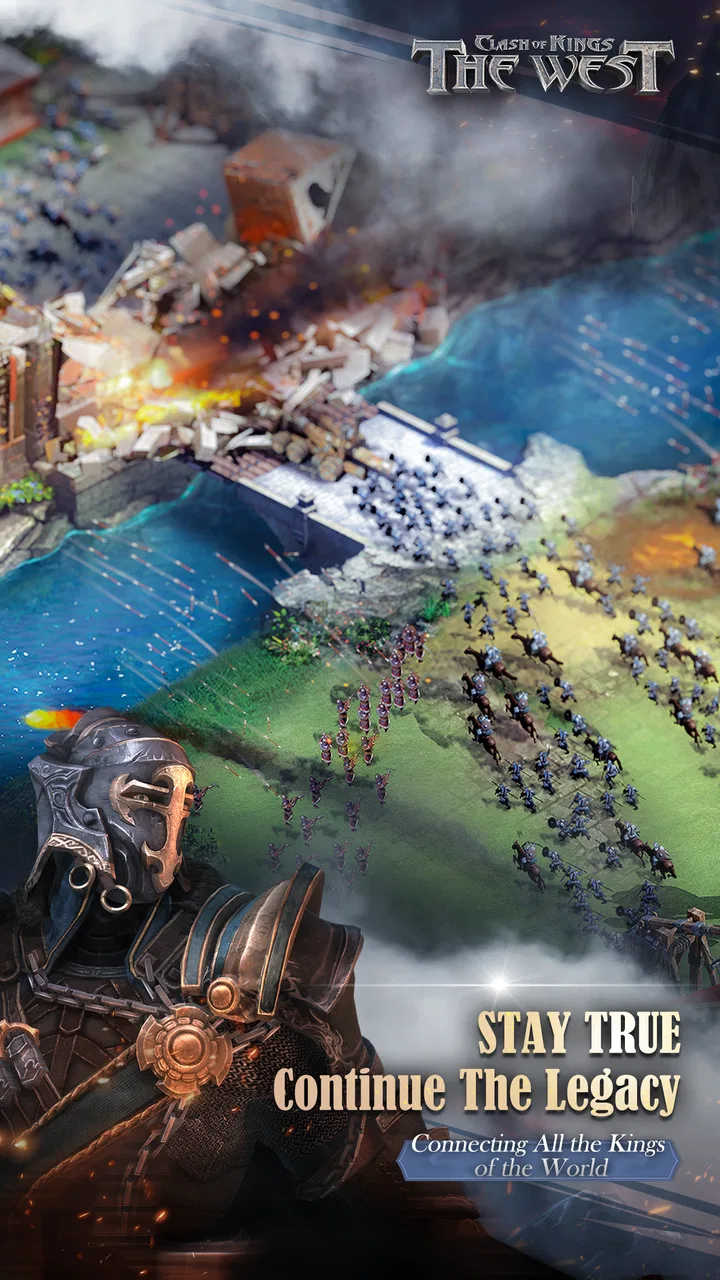
Clash of Kings: The West is a real-time strategy and kingdom-building game in which you develop a medieval empire, gather resources, construct and upgrade buildings, train armies, research technologies, and compete with other players. The game combines city management with world-map exploration, alliances, territory conflicts, and timed events, so progress depends on both long-term planning and active participation.
02Can Clash of Kings: The West be played for free?
Yes, the game can be downloaded and played without paying an upfront purchase price. However, it includes optional in-app purchases for resources, speed-ups, special items, and other advantages that can accelerate development. Free players can still make progress, but upgrading buildings, researching technologies, and recovering from losses may take considerably longer unless they log in regularly and manage resources carefully.
03Does the game require an internet connection?
Clash of Kings: The West is primarily an online multiplayer strategy game, so a stable internet connection is required for most important features. Your kingdom, alliance interactions, world-map actions, battles, events, and server communication depend on online access. Because the game is connected to a live server, it is not designed for full offline play, and connection problems can interrupt ongoing activities.
04Is Clash of Kings: The West suitable for beginners?
The game is accessible to beginners because its early quests and guided objectives explain the main systems, including construction, resource production, troop training, and research. Nevertheless, the number of menus, currencies, timers, events, and strategic options can feel overwhelming at first. New players should follow the tutorial, complete daily tasks, join an active alliance, and avoid spending premium items before understanding their value.
05Are there purchases, advertisements, or multiplayer risks to consider?
The game focuses on multiplayer competition and may include optional purchases, limited-time offers, and promotional content depending on the version and platform. Since players interact with alliances and opponents, chat and social features may expose younger users to unmoderated messages or requests. Parents should review the game’s age rating, use device purchase restrictions, and supervise online communication where appropriate.
Pros
- Strategic battles reward careful planning and adaptable troop formations.
- Regular events provide extra goals beyond the main campaign.
- Alliance features make coordinated attacks and resource sharing worthwhile.
- The medieval setting gives the kingdom-building experience a distinctive atmosphere.
- Multiple upgrade paths let players focus on military
- economy
- or defense.
Cons
- Progress can feel slow without frequent logins or carefully saved resources.
- Competitive events may favor players who invest in premium purchases.
- Large alliance wars can become difficult for newcomers to understand.
- Resource management becomes demanding as buildings and armies grow.
- Notifications and timers may feel intrusive during longer play sessions.

Clash of Kings:The West
Gallery